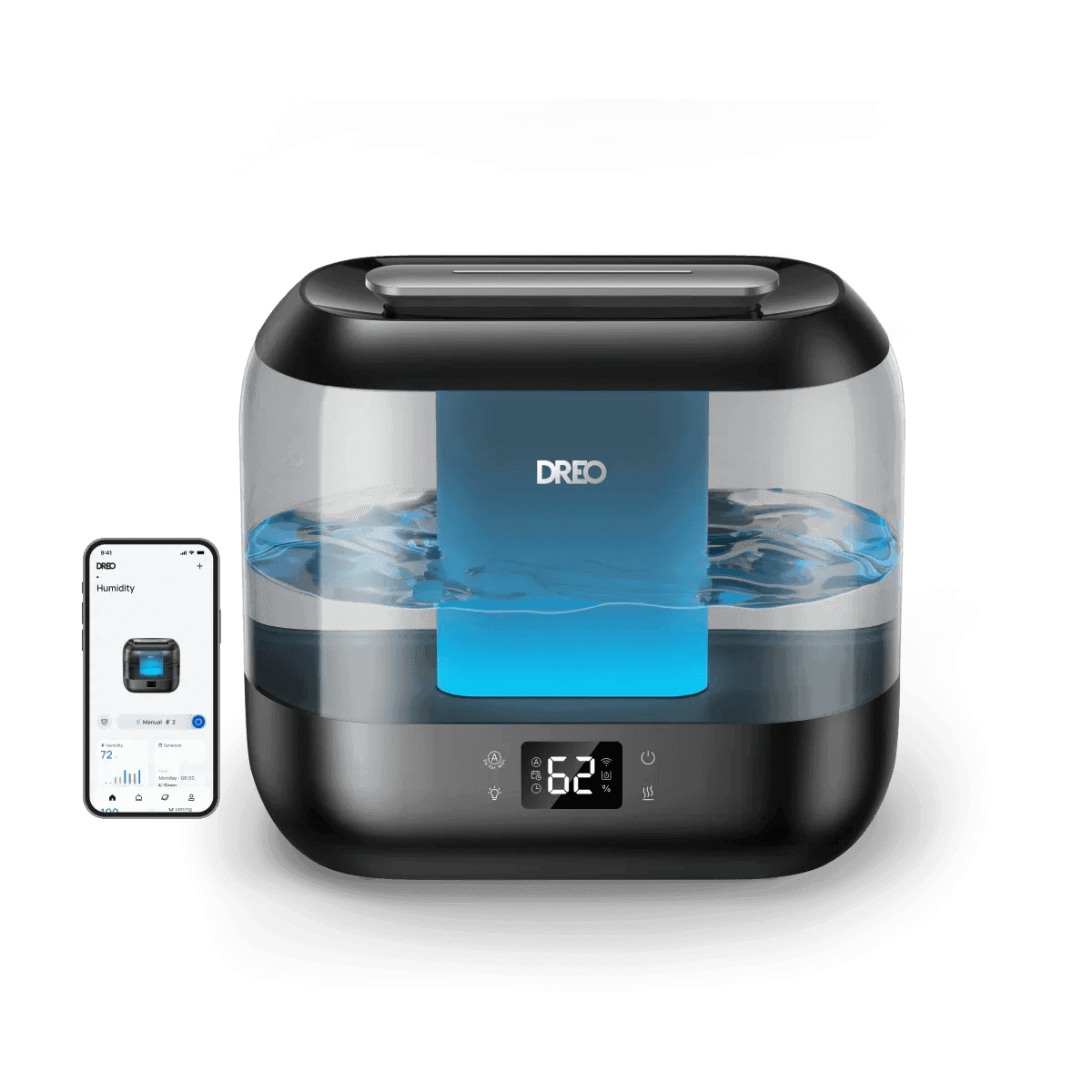
The Dreo HM311S undercuts most smart humidifiers on price while still offering app and voice control — the tradeoff is a smaller tank and a room-coverage claim that's more optimistic than independent testing suggests.
Check price on AmazonQuick specs
4L top-fill tank rated for 36 hours of runtime (independent testing measured roughly 41.6 hours), Dreo's own coverage claim is 300 sq ft, touch/app/voice control via Alexa and Google Assistant, dual-intake mist design, ambient light that reflects humidity level, and an included demineralization cartridge.
Who it's designed for
Smaller bedrooms, nurseries, or home offices — not large or open-plan rooms, despite the 300 sq ft claim. Independent testing (TechGearLab) judged it better suited to rooms under roughly 200 sq ft in practice.
Noise, honestly
Dreo rates this at 28 dB. TechGearLab's lab measurement came in at 41 dB, describing a noticeable low whine — a bigger gap between spec and reality than most humidifiers in this price range. If overnight noise is a dealbreaker, factor this in rather than the marketing number.
Worth knowing
- Some users report leaking around the water outlet valve — common enough that Dreo's own support site has a troubleshooting guide for it
- No carry handle, so the tank can be awkward to move when full
- The timer shuts the unit off completely at the end of a cycle rather than reverting to your previous setting
How it compares
- Dreo HM311S vs Levoit Classic 300S — the Dreo is the cheaper option and app-controlled either way, but the Levoit's bigger 6L tank and wider real coverage area make it the better pick for anything larger than a bedroom
- Dreo HM311S vs a basic humidifier without app control — you're paying roughly $10 more than Dreo's non-smart HM311 for touch/app/voice control; worth it only if you'll actually use the scheduling features
Bottom line
The HM311S is a reasonable budget pick for a single bedroom or small room, but the 300 sq ft coverage claim and 28 dB noise rating are both more optimistic than independent testing found — plan around a smaller room and a bit more noise than the spec sheet promises.