Robot lawn mowers used to mean burying hundreds of feet of boundary wire before the robot could do anything. The Segway Navimow i110N is part of a newer generation that skips that step entirely, using satellite-based positioning and onboard cameras to figure out your lawn's edges instead.
Check price on AmazonWhat it does
Instead of a buried wire, the i110N uses RTK (real-time kinematic) positioning combined with a vision sensor to map your lawn's boundaries the first time you walk it around your yard with the app open. Once mapped, it mows on a schedule inside that virtual boundary on its own, returning to its charging dock automatically.
Who it's for
Households with a lawn up to 1/4 acre who specifically want to avoid a wire-burial installation — that's the entire reason to choose this over a cheaper wire-based robot mower. If your yard is larger, or if you don't mind burying wire for a lower price, a traditional boundary-wire mower may be the better value.
Setup
Setup means placing the charging dock, then walking the mower around your lawn's perimeter once (or driving it via the app) while it builds a virtual map. iOS/Android app required. No trenching, no wire, no weekend spent burying cable — that's the entire pitch of this category of mower.
Performance
- Navigation accuracy — RTK-plus-vision positioning holds up well in open lawns; performance can get less consistent under heavy tree cover or right next to tall structures that interfere with satellite signal
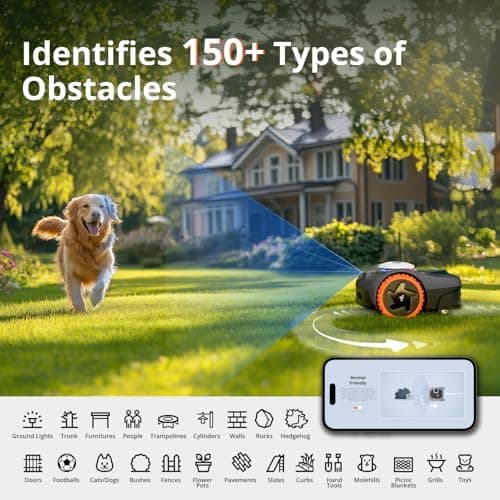
- Obstacle handling — stops and reroutes around pets, toys, and furniture left on the lawn
- Noise — notably quieter than a gas mower, quiet enough to run while people are outside nearby
- Slope handling — rated for moderate slopes; check the specific percentage against your yard before buying if you have a hilly section
Honest take on reviews
This is a newer wire-free mower category, and it shows in the review history — a 3.9-star average is solidly middling, not a slam dunk. Most of the friction reported by owners centers on initial mapping accuracy in tricky yards (dense shade, unusual lawn shapes) rather than the core mowing mechanism itself. If your lawn is a fairly open, regularly-shaped space, that's exactly the scenario this mower handles best.
Pros and cons
Pros:
- No wire burial — real time savings on setup versus older robot mowers
- Ongoing schedule requires no manual intervention once mapped
- Quiet enough to run during the day without disturbing anyone
Cons:
- Mapping accuracy can be inconsistent in yards with heavy shade or complex shapes
- Higher price than wire-based robot mowers with similar coverage
- Newer technology with a shorter review track record than established wire-based mowers
FAQs
Do I still need to bury any wire at all? No — that's the entire point of this mower; boundaries are set virtually through the app during initial mapping.
What size lawn does this cover? The i110N is rated for up to 1/4 acre; larger Navimow models exist for bigger yards.
Does it work under trees or in shaded areas? It can, but positioning accuracy is more reliable in open sky conditions — heavy tree cover is where most reported mapping issues come from.
Bottom line
If avoiding a wire-burial install is worth paying more for, and your lawn is a fairly open 1/4-acre or smaller space, the Navimow i110N delivers on that specific promise. If your yard has heavy shade or a complex layout, temper expectations on mapping accuracy — or consider a wire-based mower instead.